|
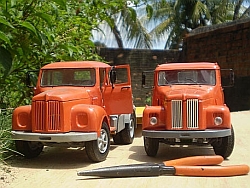
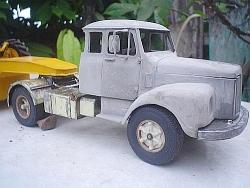
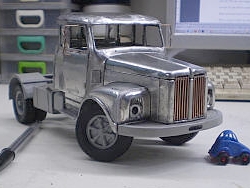
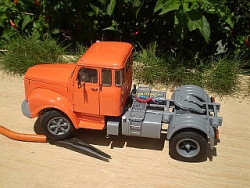
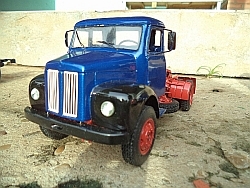
I have been planning to make the
Scania scale model for two years, but I scarcely have had time to do the
common works. Now it is time to begin the Scania.
I, humbly, intended to represent some of
the models usually seen on the roads all over the world in the past 70
years. The old models are those that I am an enthusiast.
I did not had access to the
documentation concerning the models of brand and all that I have done
about the old Scania models is based on the pictures that I have found
in the internet. The angles and the curves are
deceiving, specially seen on pictures. So, some details may not be as
accurate as one should expect. Some are not as I expected too. This is
the Scania Project “B”. In the Project “C” and son on, the improvements
will be made.
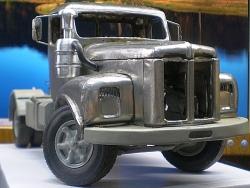
I had to make the moulds in steel.
When one has none but scarce means, the only way to do this project is
by the hard work. I am talking about actually sculpt all the moulds in
steel.
The
actual project comprehends some of the most known Scania trucks. The
scale is 1:25 and the scale models that I intend to make are:
-
02
L 36 Scania trucks;
-
02
L 55 Scania trucks;
-
02
LS 64 Scania trucks;
-
05 L 75 Scania trucks;
-
02
LS 85 Scania trucks;
-
05 L 111 day-cab Scania trucks;
-
15 L 111 sleeper-cab Scania trucks;
-
01
LS 111 sleeper-cab Scania truck.
-
01 LK 140 cab over engine
At
least 36 cabs will be made.
Many questions have been made concerning this project. Some of them
are:
Why
so many models at a time? Why duplicated?
There are any
reasons why the thing came to be this way.
Reason
1:
Since when I was working on the Brazilian FNM Truck Project (I called it
FNM project A), about two years ago, the many fans of the Scania brand
asked me for a Scania scale model. Only now I am taking the time to get
things on the way.
Reason
2:
When I make one model, I try to make as many cabs as I can. In the so
rushed day by day work with computers it is difficult to stop and make a
scale model from zero.
Reason
3:
There are so many models because, sometimes, when I make only one type,
people want other ones.
Reason
4:
There are duplicated models because even though the main idea is not to sell any
model, indeed I sell them. Sometimes, none remains in my hands. People
usually say: “Sell it to me. You can make another one for yourself at
any time.” I want to have in my collection one sample of each model a
make. Then I assume that some of the Scania scale models are to be sold.
Reason
5: When researching some truck brand, a have a
travel through its models releases and became very fond of each of them,
specially the classic ones.
Molds
I do not make prototypes out of
clay because the way I am used to make them is somehow different from
the way other people do. Instead, I prefer some types of car body
filler.
Anyway it is better to take a
whole month to make the moulds than doing the work only by hammer.
Later, if I have to make the same model, I do not have to take care
about its measures or shapes. Get better quality, not to mention that
the time to complete the model is significantly reduced.
Quality here is something that
must be explained. The models are craft work that must be good enough
within their scope and should not be compared with the ones that come
from an industrial assembly line.
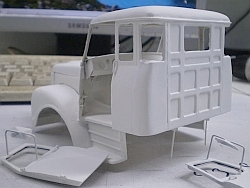
Inside the cabs
Sometimes we have to use the
experience and a bit of imagination to compound the parts inside the cab
because of the lack of access to the documentation. The similarity
between models has a big impact on the result. There are times when the
result is not what we wanted it to be, but there is not too much to be
done. Documentation is gold when trying to replicate something. I used
to write to the brands asking some data about their models, but in
general they do not care about it. After I had an insane job to make a
Mercedes-Benz Axor 2640, there is, now, plenty of documentation on the
MB site. I suppose that every scale modeler could do a better work with
the right data. But I have to admit that if my Scania models do not look
like a Scania, that is my fault. Let us let the builder alone in this
case.
The first chosen model
The first cab that I assembled is
the L111 sleeper-cab, one of the most known Scania in the world. I
adopted the Brazilian version that has a few differences from the
European one. The window in the rear corner of the Brazilian cab is larger, to
begin with.
General considerations concerning the project
Because this project deals with craft work that
implies handmade and detailed parts one by one, some preoccupations were
constant:
1 - Reach a determined quality standard;
2 - Obtain well resistant parts;
3 - The material had to be metal in at least 80% of the
parts;
4 - The parts had to be standardized and interchangeable;
5 - Reduce each part production time without changing the
quality.
Not all the aims that were stated above could be reached
here, but I hope that it can be done in the next version of the project.
More information may be added to this
article at any time.
|

 Back
Back
 Home
Home
 Thoughts
 Contact